Showing posts with label Kueh 粿. Show all posts

Friday, 24 November 2017

Kueh Tutu 嘟嘟糕 (2)

One of my favourite snack is Kueh Tutu 嘟嘟糕.  I have attempted it before in here and till now, I am still seeking for THE recipe.  

Spotted AL attempted it and hers yield a higher water ratio than the one I tried.  Somehow all recipes available are based on 1 cup rice flour.  The variable is the water ratio.  This time, it is based on 90ml.  

Thanks AL for sharing.
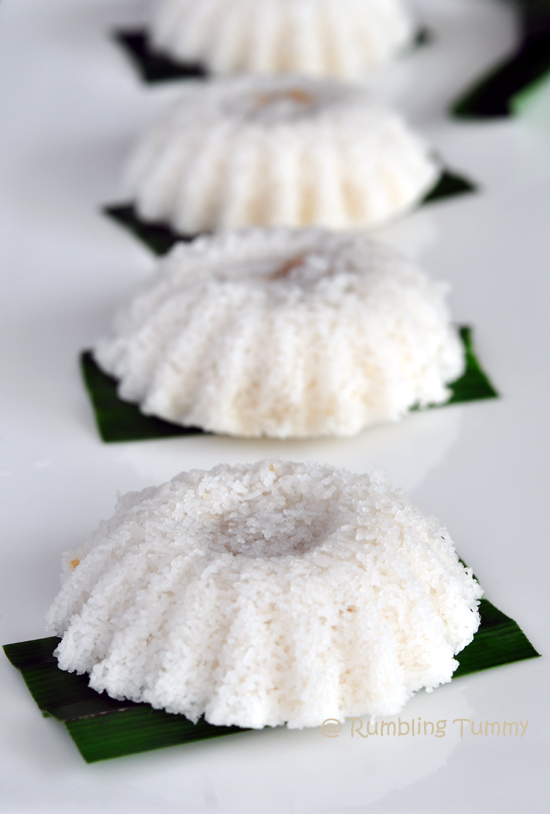


Findings: I did not fry the rice flour over the wok, instead, I used back the same method as my first attempt.

The crack rate for this is zero but somehow the tutu came out chewy which I don't know why.  Also the texture, as you can see, is not as fine as those store bought or even the one I attempted before.

I perhaps had over handle the flour?   Will the brand of rice flour matters?  or is the sieve of wrong fine-ness? 

I will definitely try this again for I think the fault lies in me.

What you need:
yield: 12 pcs


Fillings

75g gula Melaka, finely chopped
Grated coconut
¼ tsp salt

In a frying pan, add gula Melaka and simmer, stir until melted.

Add in grated coconut and salt.  Mix well.  Set aside to cool.

Tutu

1 cup rice flour
90ml water
½ tsp salt

Method:

Place rice flour on a plate and microwave it for 1½ min.

Sprinkle water using the fork, coating evenly.

Press flour through a sieve.

Place flour onto mold half way and add peanut and layer with another layer of flour.

Put a pandan leave

Cover with cloth and steam on high for 12 mins.


If you are interested in the mold, I bought mine many years ago in Ailin (Tanjong Katong Shopping Centre) but it is also available in Sun Lik (which is more expensive). 

Thursday, 1 September 2016

Kueh Getas

Over last weekend, I was invited to a gathering from a very first forum group that I joined after I became a stay home mom.  It was a long time friendship and am happy that we still remain so.

That afternoon, the company was delightful and the food, needless to say, the food that was cooked by T's hub, was super sedap.   One of the dessert served, I was totally unfamilar with it.  I have never eaten Kueh Getas and I don't recall seeing this being sold too.

Geesh.... I must tell you that it was seriously addictive and my friends who were there shared the same view too.  I don't want to count how many servings I had that afternoon!

I google and found one recipe that was very popular.  Then again, it was a translated copy and I am not very sure about one component.

Nevertheless, decided to give this a try.


Findings: Mine turned out "white" unlike the one that I ate.  It was golden brown.  The texture is kind of the same but I find mine way too sweet.

If I have any Malay readers out there who knows how to make these, hope you can share with me on this.  Terima Kasih!

What you need:

125g glutinous rice flour
10g rice flour
80g grated young coconut
65ml - 70ml water (I used 80ml water)
pinch of salt

Method:

Mix all the dry ingredients together.

Slowly add in the water and mix until a dough is form.

Shape into an oval and flatten it.  Not too thick.

Heat oil and deep fry until golden brown.  Set aside. (I was not able to achieve the golden hue)


Sugar coating

What you need:

150g sugar
75ml water

Method:

Using a med size non sticky pan/wok, cook the sugar and water until sugar dissolved.  Do not stir.

Continue to cook until it bubbly and thick.  Lift the spoon and if the syrup has a long strand, it is ready.

Add in the fried rice cake, mix well and keep mixing until the sugar is dry. 

Ready to serve.


Monday, 28 September 2015

Kuih Wajid

I chanced upon Kuih Wajid when I was trying to cook something with glutinous rice via pinterest.  I have never eaten Kuih Wajid before and was curious about the taste.


What you need:

10" square banana leaves
500g glutinous rice, soaked for 8 hours and drain
500ml coconut cream
5 pcs of pandan leaves, cut into halves
50g castor sugar 
200g gula melaka, shaved
4 pandan leaves, knotted

Method:

Lined a 10" square baking tin with banana leaf

Steam glutinous rice for 20 - 25 mins or until it is cooked.  Transfer to a large pan and spread out to cool.

In a big pot, combine coconut cream, pandan leaves and the sugars in a non stick pan.  Stir over med heat until mixture is thick and bubbly.

Add cooked glutinous rice and stir until rice is well coated and has a shiny gloss.  

Discard pandan leaves and pour it into a lined tin.

Press down the rice with the back of a big spoon.  Level its surface.

Set aside to cool before cutting.


Stay healthy!

Monday, 18 May 2015

Steam Kueh Lapis 九层糕

Among so many different type of kueh, my girl loves Steam Kueh Lapis 九层糕 the most.

I think it has to do with the approach of eating it.  I recalled when I was young, I will peel layer by layer, savouring each layer as I go along.  To a kid, this is a fun way of eating this kueh kueh.  I did notice that my girl eat it the same way too.  Are you the same as us?  Eating it layer by layer?

Anyway, I did try steaming this kueh once but I failed because my steamer was tilted.

I was told that in the early days, Steam Kueh Lapis only uses two type of flour.  It was only later on, Sago flour was added to give the shine to this kueh.  How true I really don't know.  Perhaps Peranakan friends can enlighten me.

With that information, this leads me to do a search for this kueh using sago flour and I came upon @kokken's blog which eventually lead me to Travelling foodies'.

I decided to use Travelling foodies' portion as his was already downsized and that fits my family's intake.  @kokken's also has the 4th type of flour and that heightens my curiosity.

Enough said, this is my little treat to my little girl.  She has been just so wonderful cooking meals for her injured brother.  


Sorry picture reflect a not so good kueh as it was still warm when I cut and photographed it.


Learning: I used Cocomas coconut milk as it was what I had on hand.  I usually buy Kara but I can't recall for what reason I had this.  

As I was pouring the milk into the flours, I noticed that it is very diluted.  Totally different consistency as Kara's.  

Thus I decided to hold back the syrup.  In the end, I only used 600ml.

I had prepared pandan extract from my pandan plant.  So I opted for two tone rather than 3.

My layering was off balance too because i used a 8oz scoop initially but decided to switch to a soup ladle instead.   Strangely the pandan layer is thinner than the plain layer despite using the same ladle after.

Verdict: The texture is good, it has this QQ texture, not too soft nor too hard.  Surprising I like the sweetness (now I wonder if I added in all, will it be too sweet for us?)

Overall, I won't consider this a success as I had a few blunder but am sure this is a keeper.

Reference: @kokken and Travelling Foodies,  Patricia Lee’s 娘惹风味糕点, Do what I like

What you need:

288g tapioca flour
90g sago flour
21g mung bean flour
30g rice flour
432ml thick coconut milk
390g sugar
600ml water
3-4 pandan Leaves, knotted
Pinch of salt
Food colouring (red and green)

Method : 

Grease a 7″ square baking tin with a little oil.  Place a piece of oiled banana leaves at the base.   Set aside.

Place pandan leaves and sugar in a pot of boiling water.  Stir until sugar dissolved.

Strain the syrup and dilute with water to make to 900ml.

Using a whisk, mix flours and salt well.

Pour in the coconut milk a little at a time and mix till smooth. Set aside.

Pour the pandan flavoured syrup into the flour mixture. Stir constantly till well blended. 

Strain the batter.

Divide mixture into 3 portions. Leave one portion uncoloured.  

Mix each of the other 2 portions with red and green colouring.

Place the pan in a steamer and steam until hot.

Pour in the uncoloured mixture (54g) and steam for about 4 mins.  

Repeat another layer with the uncoloured mixture and steam for about 4 mins

Steam the first 3 layers for 4 minutes each

And 4th to 6th layers for 5 minutes each

Subsequent 7th and 8th layers for about 6 minutes each and the final layer (red) for 10 minutes.

Leave the cake to cool at room temperature before cutting.


I'm submitting this post to the Best Recipes for Everyone May 2015 Event (Theme: My Favourite Desserts) organized by Fion of XuanHom'sMom and co-hosted by Aunty Young


Happy Monday!

Wednesday, 11 March 2015

Kueh Kosui ** soft even chilled

I have never been a big fan of Kueh Kosui.  Those that I ate before is either too sweet or I didn't like the texture.  Then again, I have never tried making Kueh Kosui before.  To challenge myself, I decided to give this a go.

I chose this recipe as it is really unique.  It uses mee suah (which is one of my favourite noodle) and as it omit the use of alkaline, it is even better.

What entice me further was it is best served chill and that will gives me ample of time to prepare for a party if needed.

So I decided to experiment with this recipe.  

Talking about Blessed Homemaker, I am wondering how is she doing as I lost touch with her and she has since stopped blogging.  Remembering the time our kids spent playing in Botanical garden.  If you are reading this, please contact me.  Would love to rekindle our friendship.

Thanks for sharing this wonderful recipe.  Indeed a keeper.


Verdict: I might not have blended the mee sua well and it was lumpy when I added into the flour mixtures. Thus I sift through twice to fully removed the lumps. Other than that, it is relatively easy to put together. 

Overall, as promised. This stay soft even after chilled.  In fact, I like the chilled version too and it is not coyling sweet which I like.

Definitely a keeper.


What you need:

(A)
250g gula melaka
600g water
Some pandan leaves

(B)
50g mee suah
300g water

(C)
250g tapioca flour

(D)
Grated coconut, steam with pinch of salt and let it cool before using

Method

Greased a 9” round or 9"x13" pan.

Put A into a pot and bring to boil.  Stir till sugar melts.  Leave to cool.

Put B into a separate pot to cook, bring to boil.  Leave to cool and blend to paste

Mix tapioca flour with cold gula melaka mixture and stir well

Add mee suah paste to gula melaka mixture, stir and mix well.

Sift the batter and set aside.

Steam empty pan for 5 mins.   Pour mixture into pan and steam for another 45-50 mins or until set.

Set aside to cool to room temperature and cut into small pieces.

Coat with fresh grated coconut and serve (served chill is good too)


I'm joining Best Recipes for Everyone March 2015 Event Theme: My Favourite Traditional Kueh by Fion of XuanHom's Mom and co-host by Joceline of Butter,Flour & Me


Cheers!

Wednesday, 10 September 2014

Kueh Tutu 嘟嘟糕

I had Putu Piring (with gula malacca) during the last Hari Raya when I was down in Geylang Serai.  Saw the queue was really short and decided that I need to buy some and share with my good friend VA and cousin LY.

Always inspired to make my own version of Kueh Tutu 嘟嘟糕 (with either peanut or coconut), in fact, I had the tutu mould for nearly 6 years!  


I read that the success rate is rather low and I wasn't very confident but then, I think I have to make use of my mould if not I think I will feel guilty buying it.


Way too many recipes over the internet but more or less the same.  Just varying the liquid seems to the key to a successful Kueh Tutu 嘟嘟糕.


Read from Tina's Kitchen that we should not pressed too firmly on the flour and also love the method of microwaving the flour rather than dry frying it in the pan or oven.


So today, I am trying my luck and see whether mine can pass the mark.


Findings: For my attempts, based on 60ml and 75ml water equations, both failed.  

Based on 80ml water, my Kueh Tutu 嘟嘟糕 came out soft.  Though still have I have a few cracked ones but it wasn't that bad.  As for the texture, it somehow lacks something to it.  

This recipe didn't survived the whole day test.  By the end of the day, it was hard and it cracked.

What you need:
yield: 12 pcs

1 cup rice flour

80ml water

Method:

Place rice flour on a plate and microwave it for 1
½ min.

Sprinkle water using the fork, coating evenly.


Press flour through a sieve.


Place flour onto mold half way and add peanut and layer with another layer of flour.


Put a pandan leave


Cover with cloth and steam on high for 12 mins.


If you are interested in the mold, I bought mine many years ago in Ailin (Tanjong Katong Shopping Centre) but it is also available in Sun Lik (which is more expensive).


I am submitting this post to Asian Food Fest #11 Sept 2014 : Singapore hosted by Life can be Simple.


Thursday, 24 April 2014

Hakka Orh Ku Kueh 客家粗叶黑龟糕

Two or three years ago, I organised a cook out on Heritage food in Singapore among the bloggers.  At that time I chanced upon a recipe that I remembered eating often when young.  It was Hakka Orh Ku kueh (黑龟糕) that was shared by our Hakka neighbour.  He is a very good cook and we are often blessed with him sharing all this goodies.

All was forgotten as I had trouble finding Ramie leaves (粗叶), which is a key ingredient, in Singapore.  Thanks to a friend who so kindly gave me one pot.

Anyway back to my 客家粗叶黑龟糕, for the last few months, I was worried that the ramie plant will died on me just like the mulberry plant that my aunt gave me.    Luckily after placing it under some shade, the plant flourished.  

Now it is time to try making this Hakka Orh Ku Kueh 黑龟糕 on my own.

From the internet, I only managed to come across a few bloggers who tried making this the traditional way as in the dark hue.  

Things didn’t go smoothly for this experiment.  I grew desperate when out of the 350g ramie leave puree, I only yield 12g from my 26 petal of leave.  I called my friend for help thinking that I can go to their in law’s garden to fill the remaining.  To my dismay, they actually gave me their one and only pot!  Totally touched by this gesture and totally lost too.

Asked around and either no one heard about this leaves or I have to go JB to buy them. 

If you want to know more about Ramie benefit, here is the video that explains better.


Left with no choice, I decided to just quarter the recipe and pray for the best. 

Findings: : These 5 babies didn’t turn out too badly.  The colour that came out was a deep intense green.  Due to the lack of ramie paste, thus the flavour didn't come out at all.

Next time, I make sure my plant is bushy and tall before I even think about these kueh.


This blogger is the closest to what I can recall.  


What you need:
Sweet bean fillings

300g mung bean without skin
180g fine sugar (adjust to your liking)

Method:

Soak mung bean overnight.

Steam until soft and puree to form paste.

Heat wok with 2 -3 tbsp oil.  Add in mung bean puree and sugar and cook until sugar is melted.

Cool and divide into small balls (20g)


Ramie paste

Ramie leaves (stem removed and yellow leaves removed) (I think 500g fresh ramie leaves will be sufficient) 

Method:

Wash the leaves. 

Boil water to a brisk and put in the ramie leaves .  Bring to a slow simmer and simmer for ½ hour.  The longer you cook the more fragrant.  The water will turned into golden colour, ramie leaves once soft, removed and drained. 

Rinsed with cold water and squeeze dry.

Process leaves to form a paste. 


Skin

350g Ramie paste
40g fine sugar (adjust to your liking)
150ml hot water (adjust as you mixed)
250g glutinous rice flour
50g oil for glazing

Method:

Mix all ingredients to form a smooth dough.  Cover with damp cloth for 10 mins.

Wrap fillings (skin 18g and fillings 20g) .  Press into mould and place on greased banana leaves.

Steam on medium heat for 6 mins. 

Brush with oil.


You like it?

Sunday, 27 October 2013

Pulut Tekan

I need to find recipes to finish up my glutinous rice, I need to finish up my coconut milk and I have half a jar of Kaya left from my last attempt and I needed to finish it up fast as well.  So making some Pulut Tekan is the best decision as it is easy to prepare and needed all the ingredients that I mentioned.

For the rice base, I used Travelling Foodies's recipe and as for the kaya, please refer to here.

The taste for Pulut Tekan is very much like pulut serikaya but the kaya is much thinner of course.

This is my first time making Pulut Tekan.  Before this, I didn’t even know this kueh exist.  But I must say this is really easy and fast to made, definitely able to impress your guest if you have a bottle of kaya around.


Kaya

What you need:

4 eggs (65g)
100g sugar
60g gula melaka
250g thick coconut milk
5 pandan leaves


Method:

Over a double boiler, whisk eggs and sugar until dissolved.

Add coconut milk into egg mixture and whisk till combined.  Sieved.

Cook the egg mixture until it has thickened, stirring occassionally for 1 hours over slow heat.

Remove from double boiler and cool thoroughly.

Keep it chilled in fridge for up to 2 weeks.

Serve with a slab of butter on a toasted white bread.


Note: If you like smooth texture, give it a whiz in the blender.

 
Rice Base 
What you need:

300g glutinous rice, rinsed
200ml thin coconut milk (170ml Kara “Santan Kelapa Murni” Coconut Cream  diluted slightly with 30 ml water)
1 tsp salt
3-4 pieces of pandan leaves
25-30 bunga telang (blue butterfly pea flower), can be replaced with blue food coloring or omitted totally

Method:

In a saucepan, place water and bunga telang in it and bring the water to a boil before turning down the flame to low. Allow to simmer slightly with lid on for 3-5 min before turning off flame and steep for 10-15 min. Leave to cool down slightly before use. It may help to sit the pot on a folded wet towel to cool it down more quickly.

Rinse the glutinous rice to remove excess starch and impurities present, until water is reasonably clear.

Divide the washed glutinous rice into 2 parts. Place 1 parts in a bowl and add water until rice grains are completely submerged. Place the remaining last part in a separate bowl and add bunga telang juice over it. Top up with some water if necessary, ensuring that all the rice grains are covered in the blue liquid.

Leave both bowls of soaked glutinous rice to sit for at least 6 hours, preferably overnight.

On the actual day of cooking,

Drain the glutinous rice that had soaked overnight and spread out onto two separate plates for steaming. Crush or shred the pandan leaves slightly and stuff them between the rice grains.

Add salt to thinned coconut milk and give it a good stir.

Divide the coconut milk into 2 parts, and drizzle 1 parts into the plate with “white rice” and one part into the plate with “blue rice”.

Stir thoroughly to combine coconut milk with rice grains.

Place the plates into a steamer and steam at high heat for 20 min.


Assembly

After rice is cooked, spread it into a 7" oiled square tin.  You can either choose white or blue in whatever manner.  

Pressed firmly to compact the steamed rice.  

Wait till it cool down, cut and spread kaya over it.

Serve


How was your weekend?  Mine went by way too quickly.


Cheers

Friday, 18 October 2013

Ang Koo Kueh (紅龟粿)

One of my favorite kueh is Ang Koo Kueh (紅龟粿).  I used to buy this from a stall in Cantonment Road or another one in Alexandra Road.  For the first stall, they have many varieties such as durian, mung bean, yam etc.  

As I no longer stay near there or head that way often, I have to buy from others which are really yucky and that is why for a long time, I never eaten one.  

Suddenly the crave strike and I spotted some purple sweet potatoes in the supermarket which is a rare find so I decided to make some.

This is perfect to use my new mould that I bought long ago.  Really love the dept of this rather than the plastic one that I used previously.

This recipe is based on Do What I Like's and I have tried this twice and both time I enjoyed it very much, even my kids who aren't into chewy food like it.


I also chanced upon another recipe that doesn't used sweet potato and I might want to try that soon.


What you need:

Sweet Potato Skin: 
  

200 g sweet potatoes
300 g glutinous rice flour
2 tbsp + 2 tsp oil
160 ml water (adjust accordingly)
Some red coloring (optional)

Mung Bean Filling:
200g yellow split mung beans (soaked until soft)
100 g castor sugar
½ tsp salt
2 tbsps oil
¼ - ½ cup diced shallots
Water

Method:

Sweet Potato Skin:

Steam the sweet potatoes until soft. In a bowl, mash the sweet potatoes. 

Add glutinous rice, oil and water and mix well to obtain a smooth dough. Cover with a damp cloth and leave aside. You can add a little more water if the dough is too dry.

Mung Bean Filling:

Steam the yellow split mung beans until soft. 

Add in the sugar and mash with a hand held blender.

In a non-stick wok, fry the diced onions in oil. Leave aside to cool. 

In a bowl, mix the blended split peas, salt, fried onions, oil and enough water to form a soft dough.

Shaping the Ang Koo Kueh:

Brush the ang koo kueh mould with a little oil to ease removal of the kueh from the mould. (mine I didn’t and had no problem)

Take a small lump of sweet potato dough and using your palm or a rolling pin, flatten it, into a round shape with the centre thicker than the sides.

Spoon some bean filling into the dough, pinch the sides of the dough together, and using the palm of your hand, roll it into a ball.

Press the ball into the mould firmly, to obtain the design and shape of the mould.

Tap the mould gently on the table to remove the ang koo kueh from the mould.

Place the ang koo kueh on a square piece of oiled banana leaf.

When all the ang koo kuehs are shaped, steam them in a wok over high fire for 3 minutes covered. After 3 minutes, remove the cover to release steam, then re-cover and steam for another 3 minutes over a medium fire, until the kuehs are cooked.  (I didn't do this, I steam it for 5 mins straight).

Remove the kuehs from the wok and brush them with a little oil to prevent them from sticking to each other. Serve when cool.

Notes:
Based on this mould, I used 19g dough and 18g filling.


Enjoy your weekend!


Sunday, 11 August 2013

Chwee Kueh

I always love Chwee Kueh and hubby went on to surprise me with a packet few days ago.  I didn't know they have a stall near my place.  Sadly to say, my joy was short lived, it wasn't nice!!!!

Back in 2011, I have actually done some experiments on it and it yield pretty satisfactory result.  So here I am, revisiting it once again.

A big blunder was that I over cooked the fillings while trying to multi tasked.   Will definitely try this again.


What you need:
yield: 24 pcs

150g rice flour
15g wheat starch 
25g corn starch
725ml water
1 tsp salt
2 tsp oil

Method:


Greased the cups with oil.

Mix everything together till all the lumps are gone. Sieve through. 

Pour into a pot and bring to a boil. Keep stirring till it become gluey (not thick)

Pour into the chwee kueh cup and steam on high heat for 15 mins.

Remove and serve with the radish fillings and chillis. 

Radish Fillings

What you need:

1 big packet of radish (already diced)
1/2 cup of minced garlic
1/3 cup toasted white sesame seed
lard
sugar, salt and pepper to taste
a dash of dark soya sauce (Optional)
1/2 - 1 cup water

Method
Soaked minced radish for a few min and drain well. You can taste whether it is still saltish.

Using dry heated wok, pan fry the radish till it is dry. Remove.

Add lard and fry the garlic till fragrant. Add in the radish and sugar. 

Sautee the radish till it caramelised. Add water and cook till it is soft.

Add in salt and pepper and a dash of dark soya sauce.

Once you are okay with the seasoning. Add in the toasted sesame seeds. 

Mixed well.

Sambal


7 clove garlic
10 shallots
2 tomatoes
200g chilli padi
1/8 tsp red sugar
100g belachan
1 tbsp prawn paste
1 tsp salt

Method
Pound the ingredients together.

Heat wok and oil. Add in the pounded ingredients and cook till it turned dark and fragrant.

Remove to cool and store in air tight container and place in the fridge.


Okay, go ahead and enjoy the cool Sunday.  Finally it stopped raining ... just so love the cool morning.  I wish I can go back to bed but I have to prepare for lunch soon.


Enjoy

Tuesday, 2 July 2013

Kueh Salat

This is my second time attempting Kueh Salat.  I used to love those that were from Bengawan Solo long ago but these days, I felt that the quality is no longer as good as before and it became expensive for just a tiny piece.

The last time I make this, I failed in attempt because my layer spilt.  Later on I found out that you cannot let the rice cool down before pouring in the custard to steam.  If not, the custard will not adhere to the rice.

Thus kueh salat has been a recipe that I always wanted to try again.

Remember that I bought too much glutinous rice for my dumpling experiment?  Well I need to use up those grains before weasels start to attack it.


This time round, my success was also not good.  I was trying not to use colouring but the blue and green hue from my dried blue flowers and the freshly made pandan juice didn’t come out strong at all.  In the end, I succumbed to food colouring. 

It also has a big bubble in the custard.  I am not sure whether it is due to the temperature that resulted in this.

Overall it was good but I was looking for one that is close to Bengawan Solo's. 

Well the search continues and you might see another Kueh Salat attempt real soon.

Ciao

Monday, 1 July 2013

Ondeh Ondeh (1)

It’s sure been a long time since I last made a batch of Ondeh Ondeh.  I believe my last attempt was in November 2011 and at that time, I used purple sweet potato and it was really pretty.

The craving started when I went to Maxwell Road Market and was told that they were not selling Oneh Oneh on that day.  

Thus when I was at my favourite wet market, I decided to get a bag of freshly grated coconut to make some for myself.  I couldn't find purple sweet potato so I have no choice but to use the normal variety.

I concluded that using freshly grated coconut will solved my choking problem.  Yes, those nonya kueh that I get from store always make me choked and that is why I hated it.  It just got lodged in my throat and refused to glide down.  


My hubby said I am weird but I know there are people who had the same experiment with me and that include my son.


Now I can truly enjoy my ondeh ondeh 100%.  Yea

Nevertheless, if you have the same problem as me, and still love Nonya Kueh, get freshly grated coconut.  It will definitely solved the issue.

Verdict: Very good texture and doesn't have stick in the mouth feel.

Yield : 18 pcs
What you need:

150g steamed sweet potato
150g glutinous rice flour
6 tbsp water or more
1 tsp corn oil
chopped pieces of gula melaka
freshly grated coconut

Method:

Steam the sweet potato until soft.

In a bowl, mash the sweet potato, add in the glutinous rice flour, water and oil.

Knead till a smooth dough is formed. You can add more water if the dough is dry.

Chop gula melaka into bite size pieces.

Divide dough into 20g each and wrap in the gula melaka.

Put the wrapped balls into a big pot of boiling water.

Fish them out when the ball floats.

Toss them on to a plate filled with grated coconut and coat all around the balls.


Source: Do What I Like

Happy Monday

Sunday, 24 February 2013

Kueh Dadar

While I was doing my marketing in the wet market, I chanced upon a stall selling freshly grated coconut.  I remembered while attending one of those rare baking class, the teacher mentioned about this stall too.  Since they are opened, I couldn't resist not getting a packet home for hubby loves anything with coconut. (this stall closed really early by the way)

I already had in mind what I wanted to do with it.  Turn it into Kueh Dadar!  Don't remember I ever attempted on this one or have I?  

I am not sure how to tell between a good dadar or a bad one as I don't take coconut. But hubby said it is good enough except that the skin was a little too thick.  

Despite me trying my best to spread the batter more evenly, I guess I failed.  My pan was too hot I guess as before I get a chance to spread it further, it was already set.

This is an easy dessert to make as you can space out the preparation time.

Overall, I think if my skin is thinner, I would have passed the test.

To those who made this often, any tip to share with me?